01
Lighting
The right illumination turns a defect into contrast a camera can see.

Deep-learning AOI and vision systems trained on your parts and your defect classes. Inline, at line speed, on every unit.
Machine vision exists to end all three.
Machine vision is a system of lighting, optics, cameras and software that inspects products automatically on a production line. It images every part, judges it against defined accept criteria, and passes or rejects it in milliseconds. Unlike manual inspection, it checks 100% of units, not a sample.
Real footage from our systems and our lab. No renders.
Robotic vision inspection. Geometry analysis for micron-level accuracy in complex manufacturing.
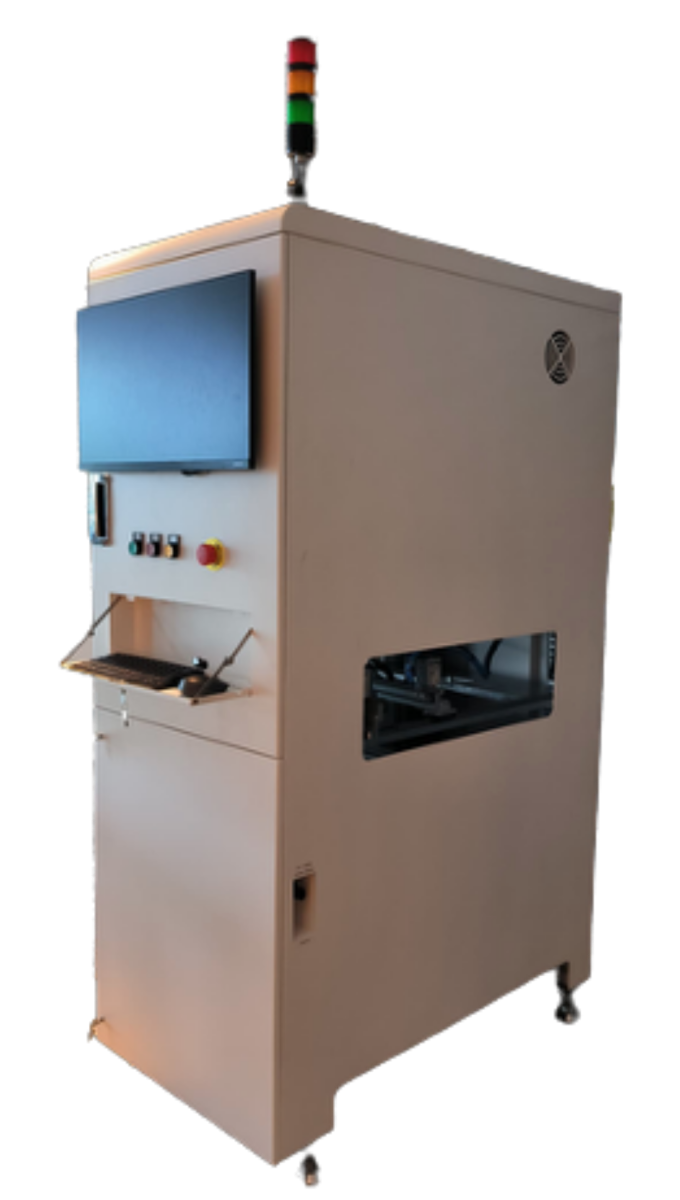
Optical inspection machine. Designed, built and supported in-house in Malaysia.
Member of the NVIDIA Inception program. Our inspection pipeline is built on the NVIDIA platform and was showcased at Computex Taipei 2026.
Most deployments combine a few of these into one inspection.
We do not sell hardware on day one. We prove the inspection works on your parts before it goes anywhere near production.
Machine vision is the use of cameras, lighting, optics and software to inspect and guide manufacturing processes automatically. The system captures an image of each part, analyses it, and acts on the result, such as rejecting a defect or guiding a robot.
AOI (automated optical inspection) is a machine vision application that visually inspects products for defects such as scratches, cracks, contamination, missing components or bad solder joints. It runs inline at production speed and inspects every unit rather than a sample.
Machine vision is the broader technology: cameras plus software making decisions on a line. AOI is one application of it, focused on visual defect inspection. Other machine vision applications include measurement, robot guidance, OCR and sorting.
Every part. A vision system inspects 100% of units at line speed and records a verdict for each one. Manual quality control typically relies on sampling, which lets defects in uninspected units escape.
Yes. With the right lighting geometry, optics and resolution, vision systems resolve features down to microns, far below what a human inspector can see reliably. Deep-learning models also stay consistent across millions of parts, where human attention fatigues.
Sample parts, examples of the defects you need to catch, and your line constraints such as speed and space. A feasibility study then confirms whether the defect can be made visible and measurable before any system is built.